Debt
Debt Payoff
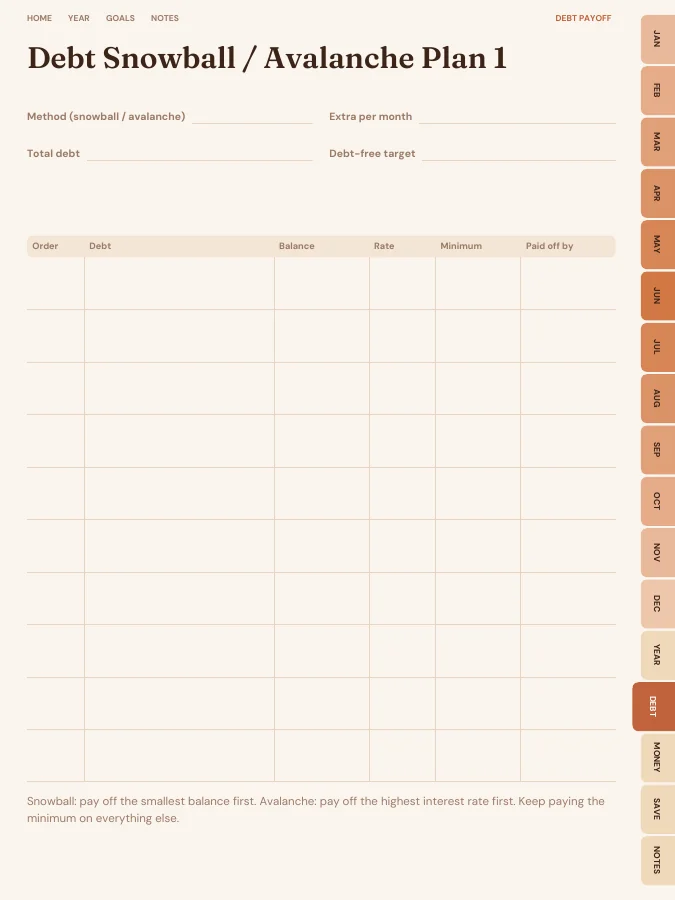
Snowball or avalanche plan and a monthly debt payment log.
- Debt Snowball / Avalanche Plan2 pages
- Debt Paymentsevery month
A debt payoff tracker, printable or digital: a snowball or avalanche plan, a monthly debt payment log, colour-in payoff trackers and a monthly budget to find the extra money.
A debt payoff planner with a snowball or avalanche plan for up to ten debts, a debt payment log for every month, debt payoff pages to colour in, a monthly budget, expense log and bill tracker, and savings pages for an emergency fund so new debt doesn't creep back.
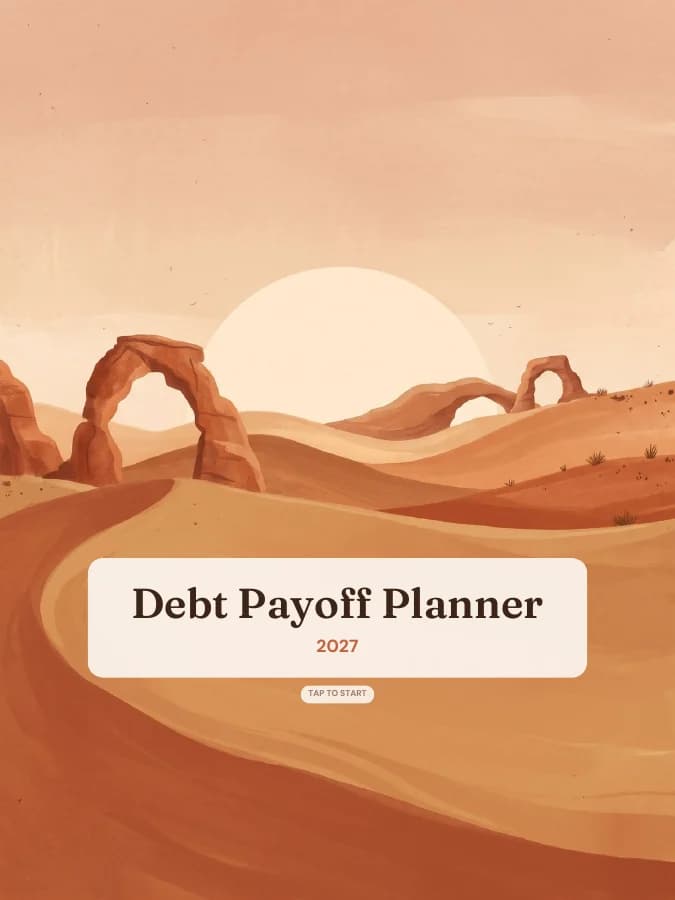
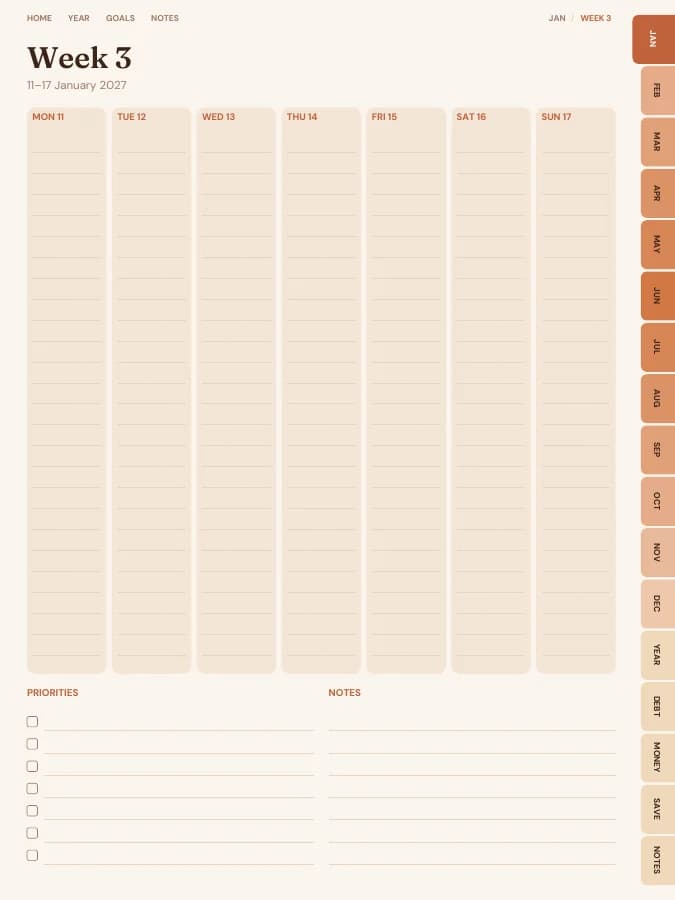
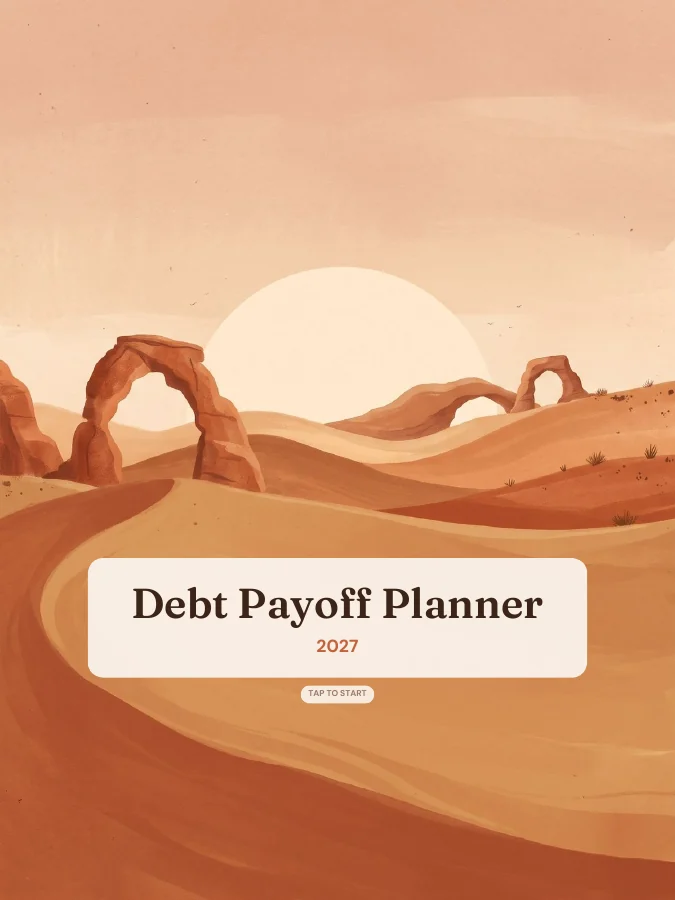
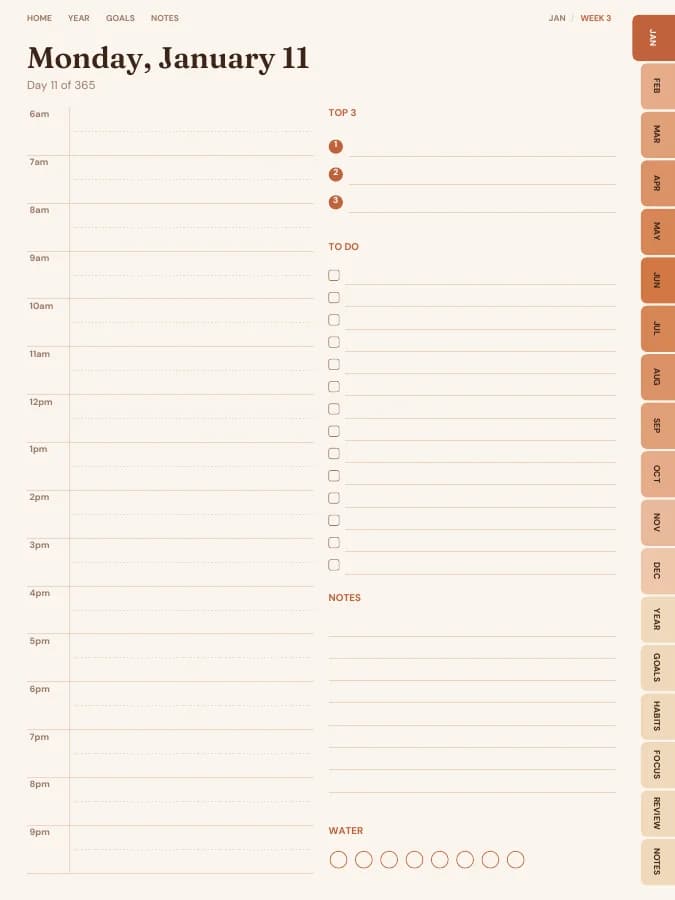
Rendered by the same engine that builds yours, in the Terracotta Sun theme for iPad portrait.
Snowball or avalanche plan and a monthly debt payment log.
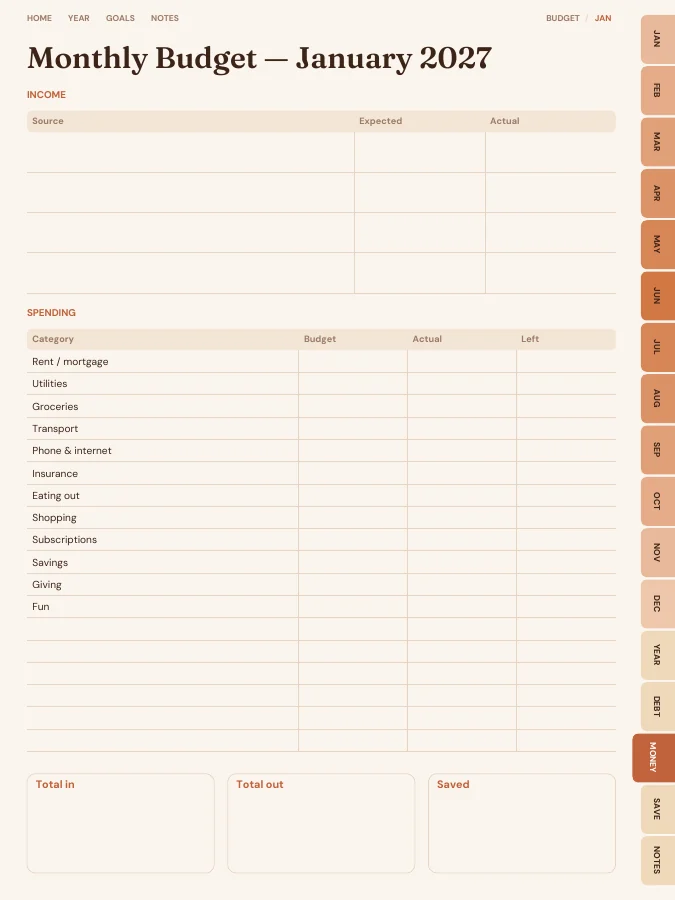
Monthly budget, expense log and bill tracker.
Savings trackers, sinking funds, debt payoff, no-spend.
Cover and contents · 2 pages
A cover with your name and a linked contents page that every tab returns to.
Year overview · 1 page
The whole year on one page. Tap any date to open it.
Year goals · 1 page
Your goals and their milestones in one place, filled in by the AI if you use it.
Monthly calendars · every month
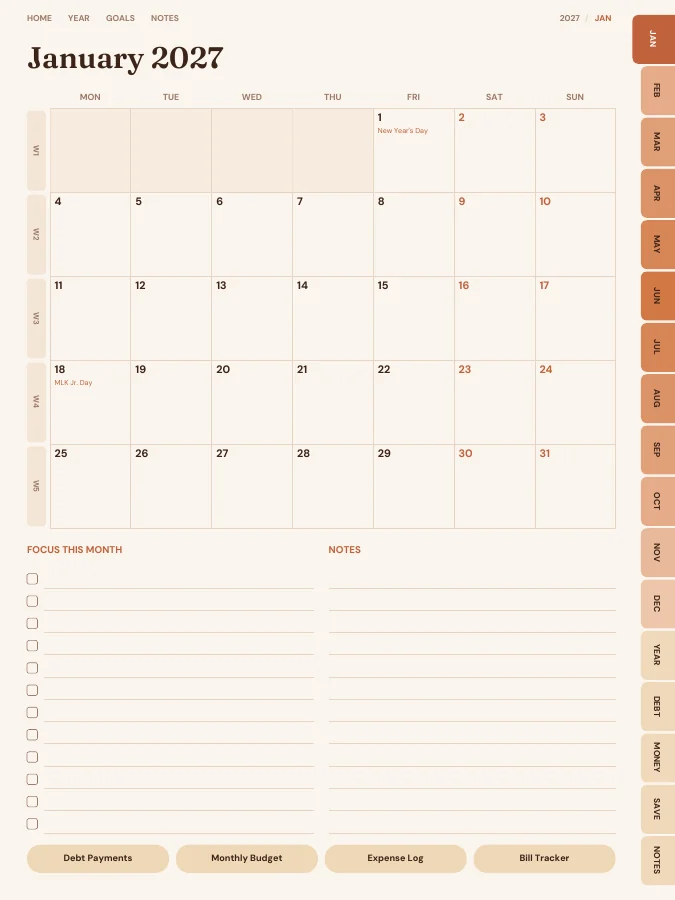
A month grid with a focus list and notes. Every date links to its day or week.
Weekly pages · every week
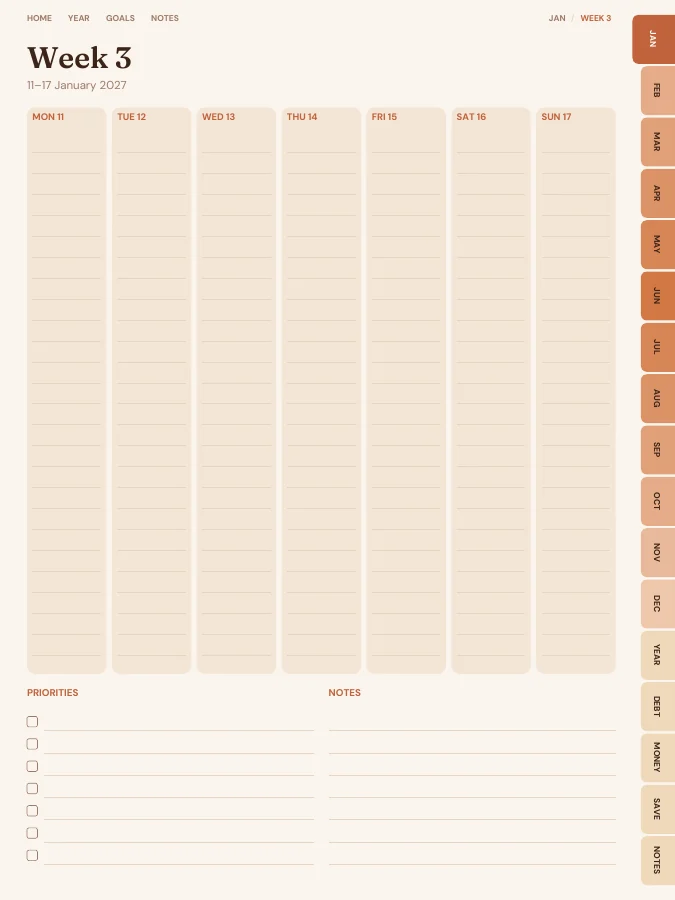
One page per week with your weekly goal actions and priorities.
Notes · 20 pages
Lined, dotted, grid or blank pages. You choose how many, up to 100.
The sample above comes to 136 pages over 12 months. Yours changes with the months, sections and notes pages you choose.
Type a goal like one of these and the AI breaks it into a milestone for each month and a small action for each week, then prints them on your month and week pages. You read and edit every line before you download.
Your goal
Pay off $8,000 of credit card debt
Your goal
Clear the car loan a year early
Your goal
Pay $300 extra on debt every month
Write each card, loan and overdraft on the plan page with its balance, interest rate and minimum payment. Seeing the total is hard, but it's the starting line.
Snowball orders debts from the smallest balance; avalanche orders them from the highest interest rate. Write the order in the first column.
Use the monthly budget and the subscriptions page to find an amount you can pay on top of the minimums. Write it at the top of the plan.
Each month's debt payment page records what you paid, the interest charged, any extra and the new balance for each debt.
When a debt is gone, add its payment to the next one on the list. That rolling payment is what speeds up both methods.
A starter emergency fund on the savings pages means a car repair doesn't go back on a card.
A debt payoff planner should show the plan, the payments and the money behind them. This one includes:
Month calendars to mark payment due dates and paydays, and a weekly page in columns. There are no daily pages, so it stays short and easy to print.
Two snowball or avalanche plan pages for up to ten debts each, and a debt payment log for every month.
A monthly budget in your own categories, an expense log and a bill tracker, to find the extra each month.
Savings trackers, sinking funds, debt payoff pages to colour in, no-spend challenges, a subscriptions audit and net-worth snapshots.
Every section can be switched off in the builder, and sections from other planners can be added.
A printable debt payoff tracker works well on the fridge or inside a cupboard door, where colouring in another square is hard to miss. Print the plan and the month's payment page on A4 or US Letter.
A digital debt planner suits people who check balances on their phone and update the planner on a tablet at the same time. It doesn't connect to your bank, so you copy the numbers in yourself.
One goal, followed through a single week. The milestone and weekly actions are the kind of lines the AI goal step writes onto your month and week pages; the daily notes are what you add by hand.
Goal
Pay off $8,000 of credit card debt
Milestone for April
Store card cleared; total below $6,000
This week's actions
iPad — Portrait
GoodNotes, Notability, Noteshelf, Xodo, Collanote, ZoomNotes
iPad — Landscape
GoodNotes, Notability, Noteshelf, Xodo
Android tablet — Portrait
Samsung Notes, Penly, Flexcil, Xodo, Noteshelf
Android tablet — Landscape
Samsung Notes, Penly, Flexcil, Xodo
E-ink tablet
reMarkable, Kindle Scribe, Boox, Supernote
Printable — A5
Print at home or at a print shop, fits A5 binders
Printable — A4
Print at home on standard A4 paper
Printable — US Letter
Print at home on US Letter paper
Printable — Half Letter
Fits Happy Planner classic and half-letter discs
Terracotta Sun
Earthy rust, ochre and sand.
Prefer something else? Pick from 13 themes, including dark mode and an e-ink theme, and change the accent colour.
See all themesSnowball pays off the smallest balance first, which gives quick wins. Avalanche pays off the highest interest rate first, which usually costs less in interest overall. Both keep the minimum payment going on everything else. The plan page works for either; write your method at the top.
No. This is a PDF planner you write in by hand on a tablet or on paper. It isn't connected to any app or to your bank, so you copy balances in yourself.
You can build this debt payoff planner and flip through every page in your browser for free, with a watermark. The tabs and links work in the preview, so you can check the layout before you pay. The clean PDF is $12 once, or included in Pro at $49 a year for unlimited planners. There is no free download of the full planner.
Yes. Download the iPad size for GoodNotes, Notability, Noteshelf, Xodo, Collanote or ZoomNotes; the Android size for Samsung Notes, Penly, Flexcil or Xodo; or the E-ink size for reMarkable, Kindle Scribe, Boox and Supernote. The links work in any app that follows PDF links, usually in read mode rather than pen mode. Every size is included in the price.
Yes. Choose A5, A4, US Letter or Half Letter in the builder for a printable PDF with a wider inner margin for hole punching. Printable and digital sizes come with the same purchase, so you can use the debt payoff planner on a tablet and print the pages you want on paper.
Dated by default, starting in January 2027. You can pick any start month and year (including this month), 12 or 18 months, and Monday or Sunday weeks. Or switch to undated and write the dates in yourself, so a skipped week isn't wasted.
Only the goal parts, and only if you want it to. Type up to six goals and the AI writes a milestone for each month and a short action for each week onto your month and week pages, plus a motto for each month. You can edit every line before you download. Everything else, from the calendar pages to the trackers, is yours to fill in by hand. You can try it 3 times a day without an account.
With the default settings it comes to about 155 pages. That includes 12 month pages, 53 weekly pages, the Debt Payoff, Budget and Savings & Debt pages and 20 notes pages. Switching off daily pages or sections makes it shorter, and the builder shows the total as you change things.
Set your dates, device and goals, flip through the preview free, and pay only when it's right.
Build this planner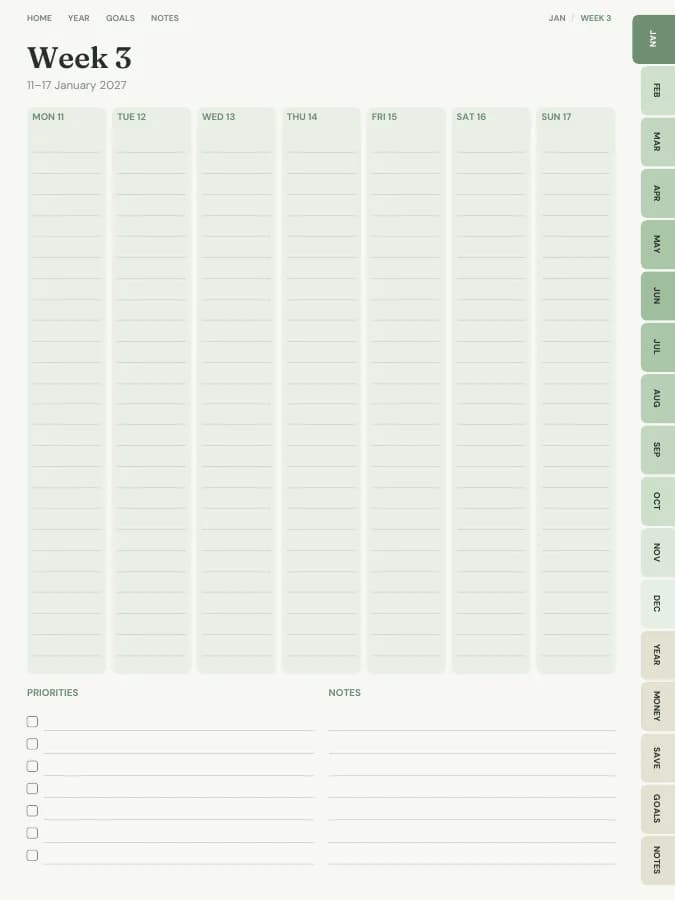
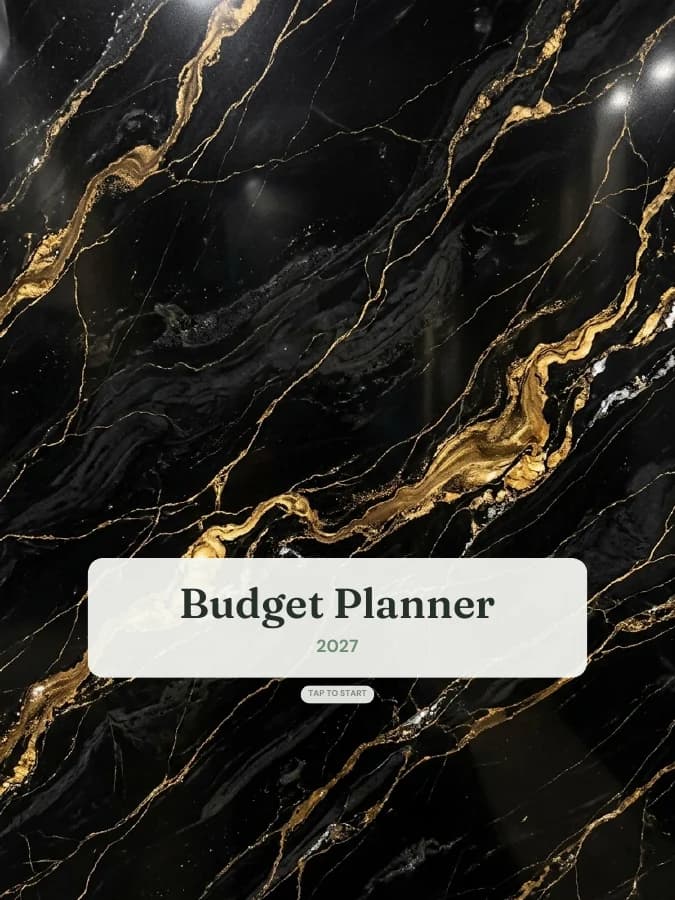
Monthly budgets, bills, savings and debt payoff — in your own categories.
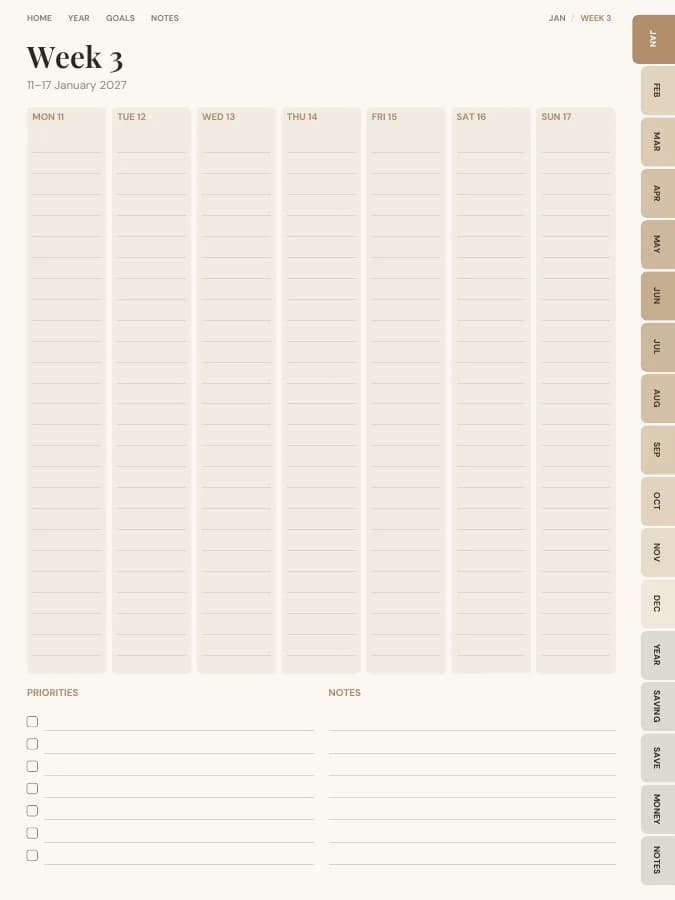

Colour in your way to a savings goal with the 52-week, 100 envelope and no-spend challenges.
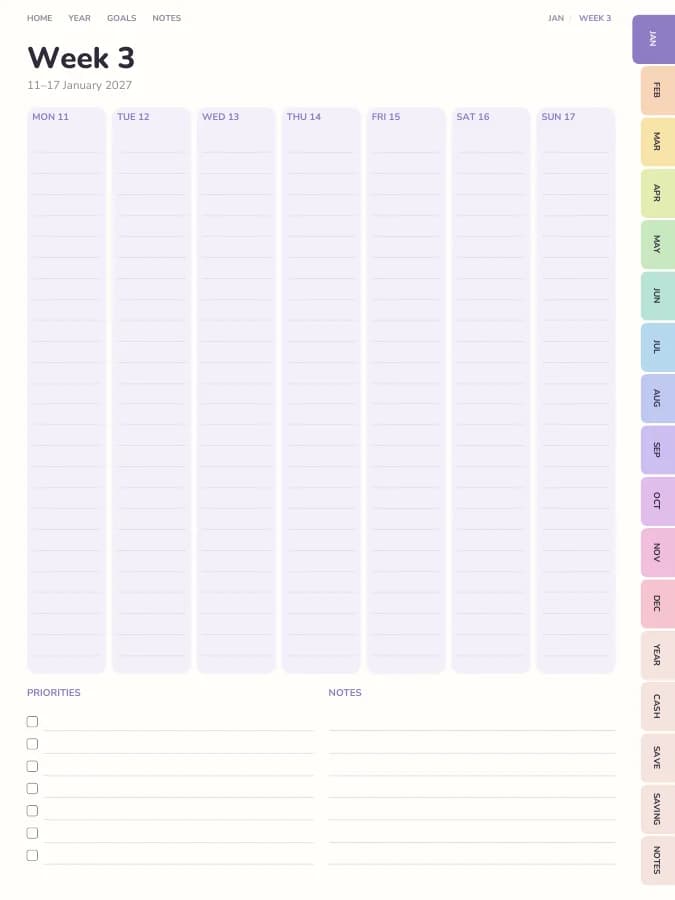
Plan each paycheck's envelopes, track what's left, and roll the extra into savings.

Type your goals. Get a planner with every milestone already on the right page.